

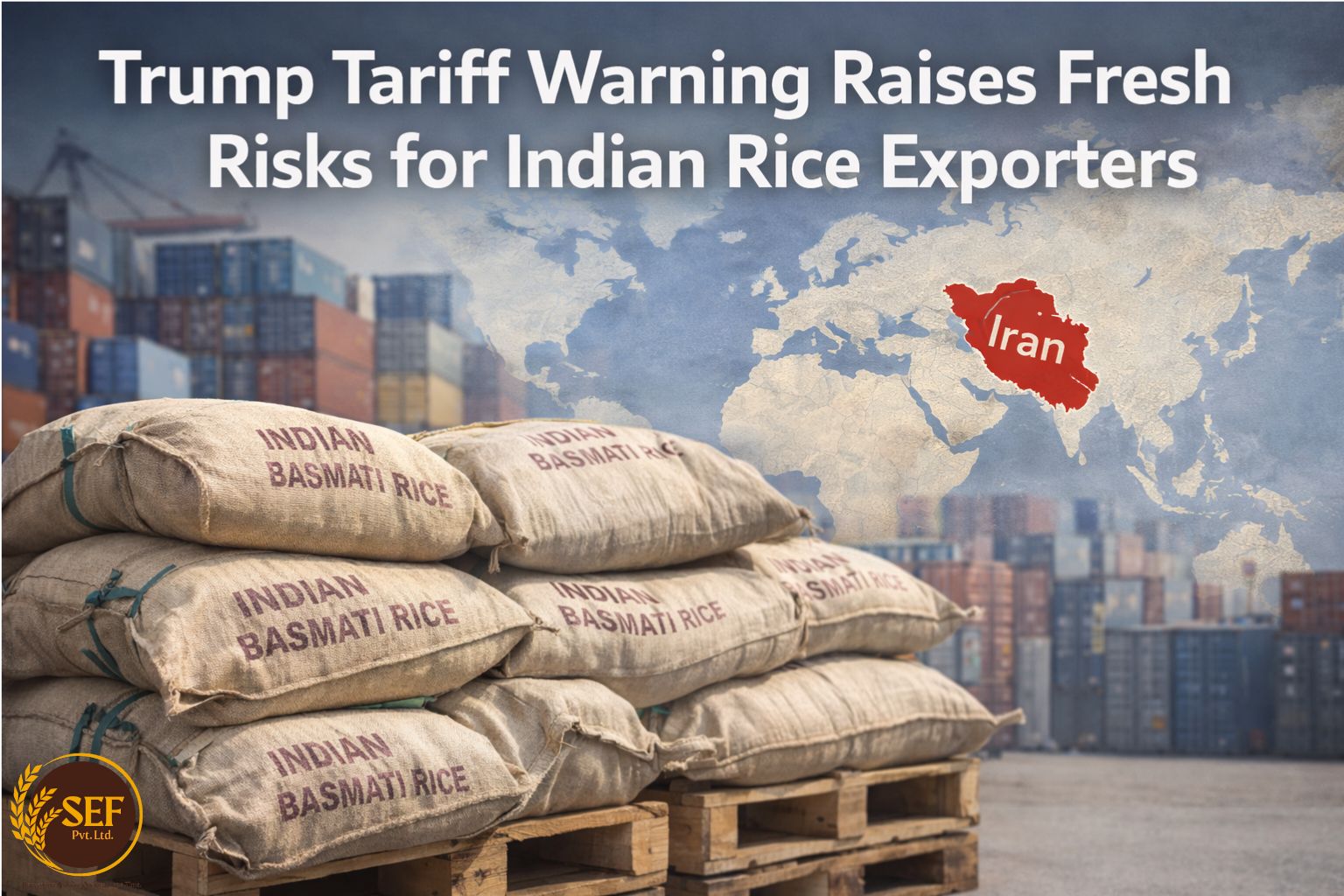
The Indian rice export sector is facing renewed uncertainty after former US President Donald Trump warned of imposing a 25% tariff on countries that continue trade with Iran. Industry experts say the move could indirectly affect India’s rice exports, especially Basmati shipments.
Iran remains a major destination for Indian Basmati rice. Any disruption in trade flows may impact exporters, traders, and farmers across key producing regions.
Iran Market Uncertainty Weighs on Basmati Trade
India exported Basmati rice worth $468.10 million to Iran between April and November of the current financial year. Total shipments during this period reached 5.99 lakh metric tonnes, according to industry data.
Exporters now fear payment delays and reduced buyer confidence. Financial channels linked to Iran may face restrictions. This could slow shipments and raise transaction risks for Indian sellers.
According to the Indian Rice Exporters Federation (IREF), stress has already emerged in trade linked to Iran. Market volatility and internal instability have weakened demand.
Domestic Prices Reflect Export Concerns
The impact has begun to show in domestic markets. Indian rice prices, especially Basmati varieties, have softened in several mandis. Traders report hesitation from overseas buyers and delayed contracts.
Prem Garg, National President of IREF, said Iran has long supported India’s Basmati exports. He added that recent instability has slowed payments and affected confidence. As a result, prices reacted sharply within days.
If uncertainty continues, exporters may face higher inventory costs. Farmers could also feel pressure at the farm-gate level.
Exporters Advised to Diversify Markets
IREF has advised exporters to adopt secure payment mechanisms. It has also urged companies to diversify into alternative destinations across West Asia, Africa, and Europe.
India remains one of the world’s leading suppliers of rice. Many analysts believe strategic planning can help protect exporters and farmers. Monitoring geopolitical risks has become essential for the sector.
Tracking global demand trends, Indian rice prices, and movements among the top 10 rice exporters in India will remain crucial as trade conditions evolve.