

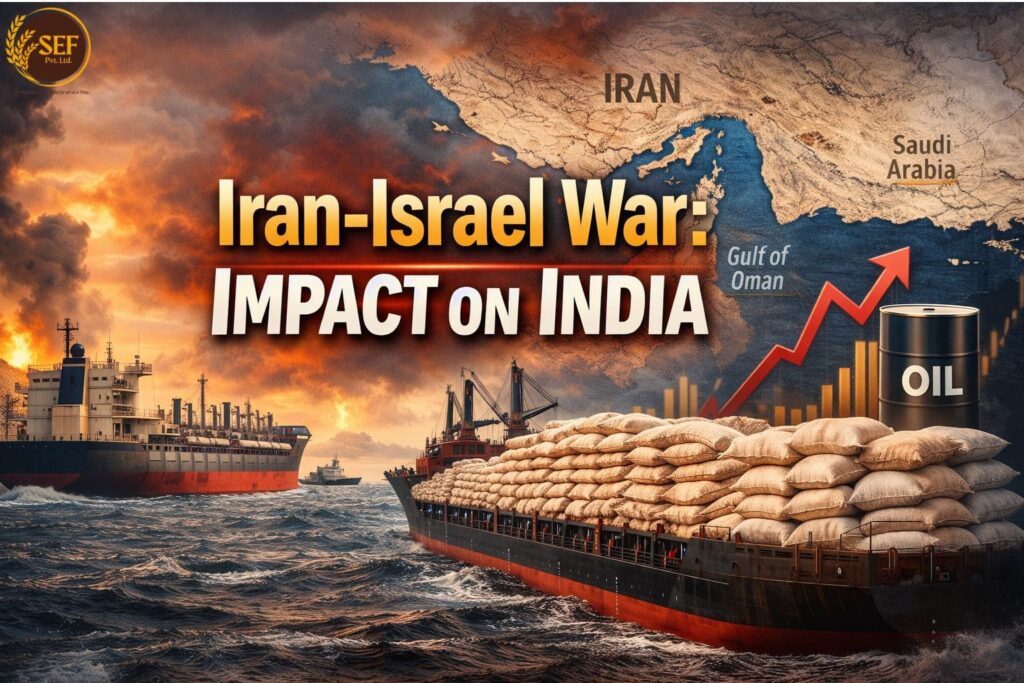
Rising tensions between Iran and Israel are beginning to affect India’s economy. From kitchen staples to crude oil, several sectors now face pressure.
Strained shipping routes, volatile oil prices, and restricted airspace are increasing costs. As a result, Indian households and exporters may feel the impact if tensions continue.
Pulses, Rice & Food Inflation Risks
First, food prices could rise. India imports approximately 5–6 million tonnes of pulses annually. These include tur, urad, and lentils from Myanmar, Canada, and Africa. If freight costs climb, landing prices will increase. Retail prices may follow.
Rice exports face separate challenges. According to the Indian Rice Exporters Federation (IREF), exporters should avoid new CIF contracts for Gulf markets. Instead, they recommend FOB agreements to reduce freight and insurance risk.
If disruptions continue, exporters may adjust shipment schedules. This could indirectly affect current Indian rice prices, especially premium basmati varieties.
India exported nearly 60 lakh tonnes of basmati rice in 2024–25. West Asia remains a key buyer.
Strait of Hormuz: The Critical Chokepoint
The strategic Strait of Hormuz handles nearly 20% of global oil trade. Over 40% of India’s crude imports pass through this route.
If the corridor closes or faces restrictions, shipping costs will rise sharply. Insurance premiums may also increase. Exporters already report delays in container movement.
Additionally, tensions in the Red Sea have increased maritime risk.
Onions & Fresh Produce Exports Disrupted
Onion shipments to West Asia have slowed. This comes at a time when demand usually peaks due to Ramadan.
West Asia accounts for about 15% of India’s onion exports. However, port closures and logistics bottlenecks have stalled consignments.
Domestic onion prices remain low at ₹9–10 per kg. Farmers in Maharashtra have already expressed concern over weak prices.
Textiles & Garments Face Delays
India’s textile exporters now face longer transit routes. Ships may bypass the Gulf waters and travel via the Cape of Good Hope. This adds 20–25 days to delivery timelines.
Tiruppur, India’s knitwear hub, produces over 40% of knitted garments. The fashion industry depends on strict seasonal cycles. Even small delays can cause financial strain.
Airspace restrictions in Gulf transit hubs may further disrupt exports.
Gems, Jewellery & Bullion Under Pressure
Surat, India’s diamond processing center, could see supply challenges if rough diamonds and bullion shipments slow.
India cuts and polishes nearly 90% of the world’s diamonds. Dubai acts as a major transit hub for gold and rough diamonds.
In 2025:
- Gold imports crossed $16 billion.
- Rough diamond imports via Dubai exceeded $7 billion.
- Gold jewellery exports rose strongly under the India-UAE trade agreement.
However, geopolitical uncertainty may trigger volatility in gold and silver prices.
Electronics & IT Exports at Risk
India exports electronics worth $4.5 billion to Gulf nations, largely through the United Arab Emirates.
Restricted airspace and higher sea freight rates could slow smartphone and electronics shipments.
The IT services sector may also face slower growth if oil prices remain elevated and Gulf economies reduce spending.
Fertilisers & Kharif Season Concerns
India imports large quantities of urea and DAP. West Asia supplies a significant share.
Iran produces major volumes of ammonia and urea. Any disruption could increase fertiliser prices ahead of the kharif sowing season.
Higher fertiliser costs would increase the government’s subsidy burden and pressure farmer margins.
Oil Prices Surge: Direct Impact on Indian Households
Brent crude recently crossed $82 per barrel after regional escalation.
For India:
- Every $1 increase in crude raises the import bill significantly.
- Petrol, diesel, and LPG prices may rise.
- Inflation and fiscal deficit risks could increase.
India holds crude reserves for roughly 74 days. Alternative suppliers like Russia and the US offer some cushion. However, prolonged tension could push crude towards $90–110 per barrel.
Broader Economic Impact
If tensions continue:
- Freight and insurance costs will rise.
- Export margins will shrink.
- Essential imports may become expensive.
- Inflation pressure could increase.
From food staples to fuel, the Iran-Israel conflict highlights India’s economic exposure to West Asia.
For now, policymakers and exporters are monitoring the situation closely.