

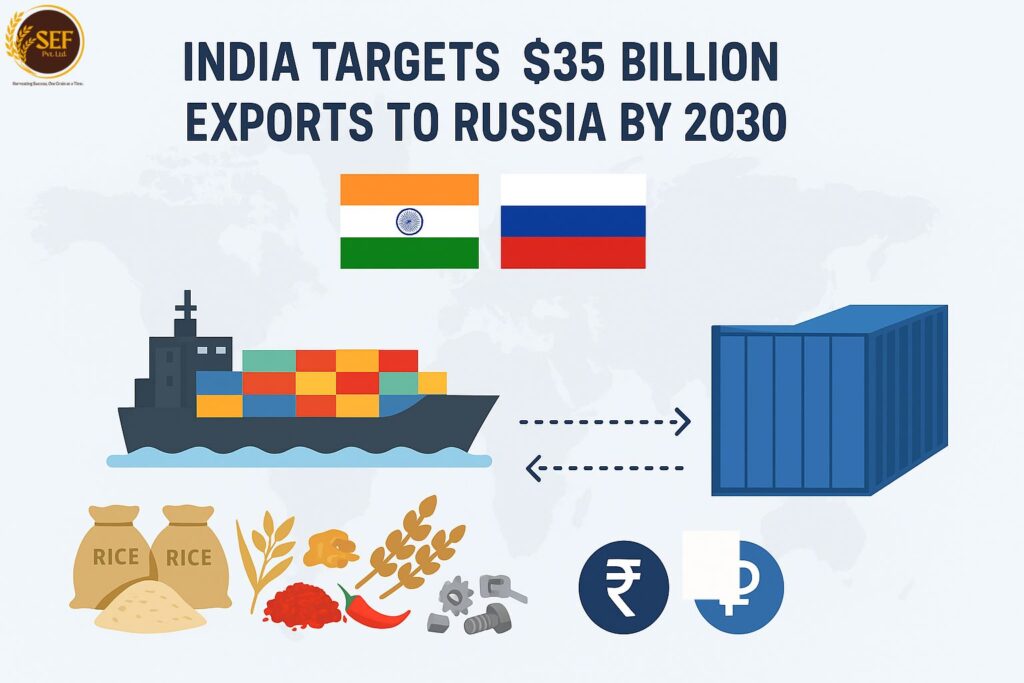
India is gearing up for a major expansion in bilateral trade with Russia, with experts stating that exports can rise from the current $5 billion to $35 billion by 2030. According to a recent analysis by the Global Trade and Research Initiative (GTRI), this goal is achievable but only if India and Russia establish a modern Rupee–Rouble settlement system that ensures predictable, low-cost, and fast payments.
Current Trade Reality: Big Potential, Big Imbalance
India–Russia trade is approaching $70 billion, but the relationship remains heavily skewed towards Russian exports.
In FY2025:
- India’s exports to Russia: $4.9 billion
- India’s imports from Russia: $63.8 billion
- Trade deficit: $58.9 billion
- Crude oil imports alone: $50.3 billion
Experts say that without payment reform, India risks remaining “an oil-heavy buyer not a balanced partner.”
Where India Is Missing the Russian Market?
In 2024, Russia imported $202.6 billion worth of goods.
India supplied just $4.84 billion, a 2.4% market share.
Huge Gaps in Key Sectors (Russia import vs India export)
Food & Agriculture
- Fruits & nuts: Russia imports $4.34bn vs India exports < $250m
- Edible oils: $1.21bn vs very limited Indian share
- Meat: $889m vs India $3.95bn global exporter but tiny supplies to Russia
- Dairy: $518m vs negligible Indian presence
- Cereal-based foods: Russia imports $689m, India exports just $0.6m
- Processed fruits & vegetables: $1.15bn vs India $42.7m
This gap highlights massive scope for Indian food suppliers, especially those featured among the top 10 rice exporters in India and the top 10 rice exporter companies in the world. Rising inquiries in Russia for Indian long-grain rice also align with current rice prices in India remaining competitive.
Consumer Goods & Chemicals
- Perfumery & essential oils: $3.13bn vs India $21.8m
- Soaps & detergents: $1.07bn vs India $29.1m
- Tobacco: $966m vs India $37.5m
Pharmaceuticals
- Russia imports $11.8bn
- India exports $413.5m (only 3.5% share)
Despite India being a $23bn global pharma exporter, it is under-represented in Russia.
Textiles & Apparel
- Knitwear imports: $3.65bn, India exports $24m
- Woven garments: $3.03bn, India exports $76m
- Man-made filaments & fibers: Russia imports over $1.2bn, India contributes very little
Engineering & Machinery
- Industrial machinery: Russia imports $37bn, India exports $1.1bn
- Electrical equipment: $20.5bn vs India $424m
- Optical & medical instruments: $7bn vs India $130m
- Vehicles: $29bn vs India $45m
- Furniture: $2.3bn vs India < $4m
Further, these numbers show that India has global export strength but lacks market penetration in Russia.
Why a Modern Rupee–Rouble Payment System Is Crucial
With Russian banks restricted from SWIFT, payments have become:
- Slow
- Costly
- Unpredictable
- Bureaucratic
Exporters say this is the single largest barrier preventing expansion into the Russian market.
A modern bilateral settlement mechanism could:
- Reduce currency volatility
- Speed up settlements
- Lower bank charges
- Improve pricing predictability
- Encourage long-term contracts
- Allow SMEs to enter the Russian market
In the Soviet era, India and USSR used a rupee–rouble trade model, today’s exporters say a modern version is essential.
Government Response
The Ministry of Commerce is examining new mechanisms, including:
- Digital settlement rails
- Blockchain-based trade systems
- Bilateral banking corridors
- A hybrid system inspired by UPI’s instant settlement
Officials believe these steps are critical to support India’s ambition of becoming a major agriculture and FMCG supplier to Eurasia.
What India Must Build to Reach $35B by 2030
GTRI recommends:
- A predictable local-currency settlement system
- Stronger logistics + certification frameworks
- Targeted buyer–seller meets
- Dedicated trade missions in Russia
- Support for exporters on compliance, documentation, and distribution
Moreover, if these structural fixes are implemented, India can realistically scale exports from $5bn to $35bn, narrowing the trade deficit and expanding its Eurasian economic footprint.
Conclusion
India’s $35 billion export ambition for Russia is realistic but hinges on one major reform: a modern and reliable Rupee–Rouble payment system. With Russia’s large import demand and India’s strong position in agriculture, textiles, pharma, and engineering, streamlined transactions can unlock massive bilateral trade potential.
A stable payment framework, combined with aggressive market outreach, could help Indian exporters, especially those in food, rice, and manufactured goods, finally secure a meaningful share in Russia’s $202 billion import market.