

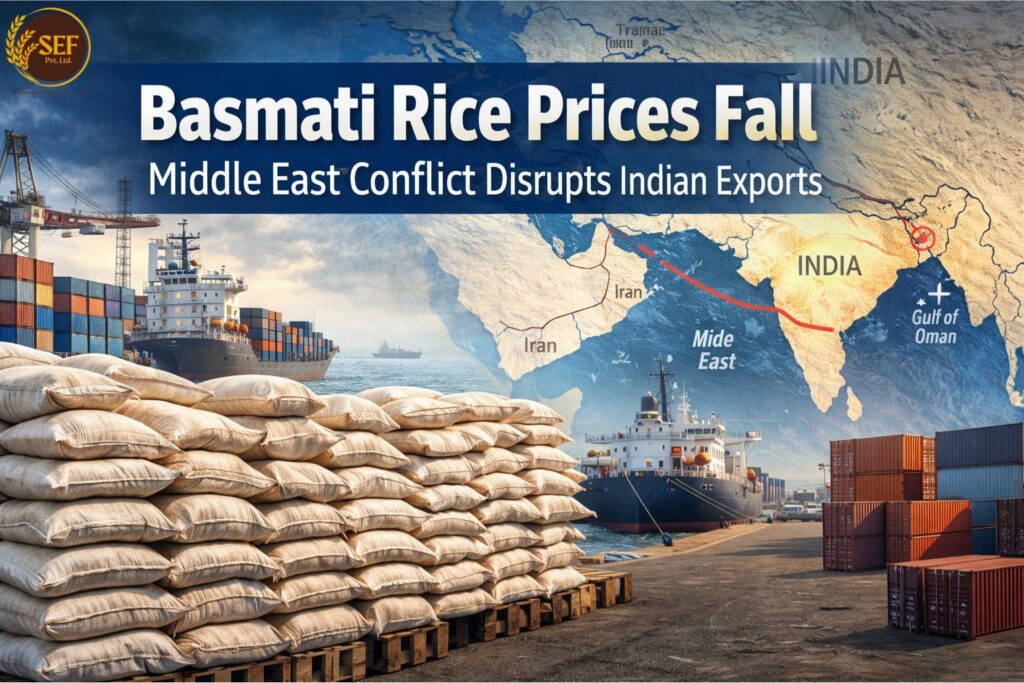
India’s basmati rice market has started to feel the impact of rising tensions in the Middle East. Local prices for the premium grain have already declined by around 5–6 percent as export shipments face disruption.
The Middle East is a crucial market for Indian basmati rice. It accounts for nearly half of India’s overseas basmati trade, which is valued at close to ₹50,000 crore each year. When shipments slow down, domestic supply rises and prices in the local market begin to soften.
Industry leaders now warn that prices could fall further if the geopolitical situation continues.
Export Disruptions Increase Domestic Supply
Exporters say the ongoing conflict has interrupted several shipments heading to West Asia. According to industry estimates, nearly 200,000 tonnes of basmati rice remain stuck at ports, while another similar quantity is currently held up in transit.
Because India exports a large share of its production, even a small disruption in shipments can quickly affect supply levels in the domestic market.
Traders believe that if exports remain slow in the coming weeks, the additional supply may put further pressure on current Indian rice prices.
February Price Surge Reverses Quickly
Interestingly, basmati rice prices had moved in the opposite direction only a few weeks ago. During February, prices increased by 5–10 percent across several basmati varieties.
Strong export demand drove that rise. Buyers from Iran increased purchases due to geopolitical uncertainty and concerns about supply disruptions.
Government trade data shows that Iran alone accounts for almost 40 percent of India’s basmati rice exports.
However, the recent escalation in the regional conflict has now reversed that price trend.
Export Slowdown May Continue
India exports more than 75 percent of its basmati rice production each year. As a result, the domestic market depends heavily on global demand.
If shipments remain slow for an extended period, traders expect additional price corrections. However, experts also note that rice consumption patterns differ across regions. Because of this, lower prices do not always result in stronger domestic demand.
As a result, the market may continue to see moderate price fluctuations in the short term.
Exporters Avoid Panic Selling
Despite the uncertainty, exporters are not rushing to sell their stocks at lower prices. Most traders expect the situation to stabilize once shipping routes normalize.
Many exporters believe that the disruption could be temporary. As a result, they prefer to wait rather than sell inventory at discounted rates.
Industry participants also remain hopeful that diplomatic developments could ease tensions and restore normal trade flows.
Limited Impact on Farmers
The decline in prices is unlikely to affect farmers significantly. Most basmati growers had already sold their produce earlier in the season when prices were stable.
Therefore, the current decline mainly impacts traders and exporters holding inventory.
However, if export disruptions continue for several months, future planting decisions and procurement prices could face pressure.
Exporters Seek Government Support
Industry groups have approached key government bodies to address the challenges created by the conflict. Exporters have reportedly held discussions with:
- Agricultural and Processed Food Products Export Development Authority
- Directorate General of Foreign Trade
- Ministry of Commerce and Industry
Exporters have requested relief on port charges and assistance in managing higher insurance costs imposed by shipping companies.
These measures could help reduce the financial burden on exporters during the current disruption.
Outlook for Current Indian Rice Prices
Market analysts believe that the direction of current Indian rice prices will largely depend on how long the conflict continues.
If shipping routes reopen soon, prices may stabilize quickly. However, a prolonged disruption could increase domestic stocks and push prices lower.
For now, exporters and traders remain cautious while closely monitoring developments in the region.