

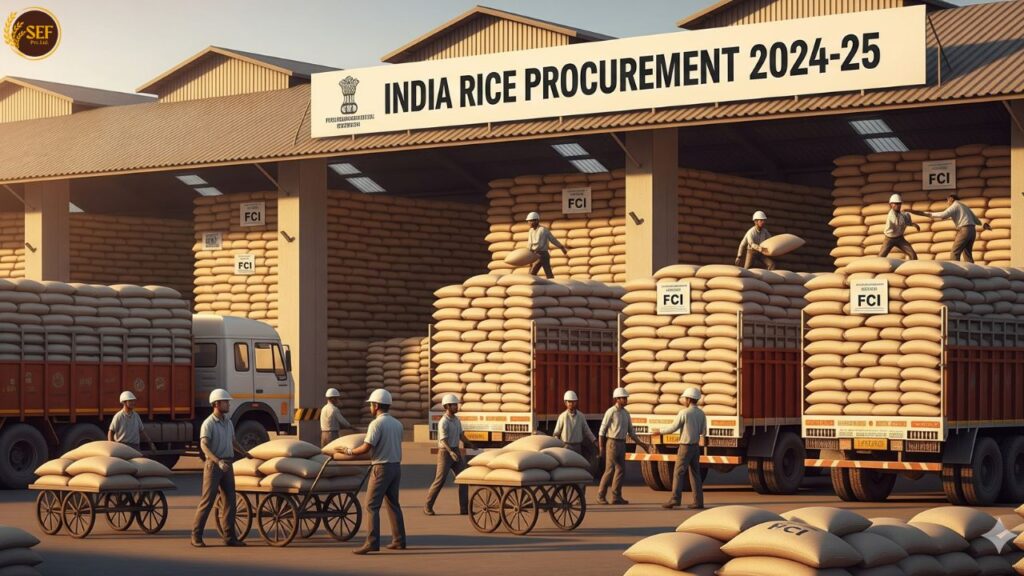
India’s rice procurement for the 2024-25 season has climbed to 545.22 lakh tonnes (lt) by the end of August, marking a 4% increase from 525.22 lt last year. The rise highlights both strong government support and robust farm output. However, this surplus is creating new challenges in managing stocks, even as the Centre initiates direct sales to traders.
Procurement Trends Across States
According to official data, the procurement so far includes 474 lt from kharif crops and 71 lt from rabi crops. Major contributors include:
- Punjab: 116.13 lt
- Haryana: 36.17 lt
- Telangana: 71.25 lt (higher than last year’s 63.86 lt)
- Chhattisgarh: 78 lt (slightly down from 83 lt last year)
- Tamil Nadu: 28.26 lt, surpassing targets
The Centre also procured 25.60 lt from Andhra Pradesh and 50.12 lt from Odisha, while Uttar Pradesh, Bihar, West Bengal, and Madhya Pradesh contributed sizable quantities.
Meeting Demand vs. Managing Surplus
India requires around 410 lt of rice annually to meet demand through the Public Distribution System (PDS) and welfare schemes. The buffer norm for October 1 is 102.5 lt. Yet, by August, government stocks had already touched nearly 380 lt of rice and 213.52 lt of unmilled paddy, equal to 143 lt of rice.
This situation raises concerns about storage space as the next procurement cycle begins in October. Officials note that the Food Corporation of India (FCI) has allowed traders to directly buy between 1–9 tonnes of rice from depots at a reserve price of ₹2,800/quintal, in an effort to ease stock pressure.
Prices, Policy, and Global Perspective
The government has fixed the paddy MSP for 2025-26 at ₹2,389/quintal, compared to ₹2,320 in the previous year. Meanwhile, certain states such as Odisha and Chhattisgarh are offering bonus payments above MSP, raising procurement costs.
In addition, 52 lt of rice has been earmarked for ethanol production, to be sold at ₹23.20/kg from November onwards. While this may partially ease surplus, experts warn of rising food subsidy expenses if stocks are not reduced.
For traders and buyers, these developments are crucial in tracking Indian rice prices, which remain closely linked with procurement volumes and storage levels.
India’s Global Role in Rice Trade
India is already the world’s largest rice exporter, with overseas shipments supporting millions of farmers. Keeping an eye on the top 10 rice exporter companies in World and analyzing the top 10 rice exporters in India offers perspective on how government procurement policies shape both domestic markets and global trade.
Conclusion
India’s 4% rise in rice procurement shows strong agricultural output but also highlights the looming challenge of surplus management. With direct depot sales, ethanol allocations, and MSP hikes in play, the government’s approach in the coming months will be critical. For consumers, the outcome will directly affect rice prices in India, while for exporters, it may determine competitiveness in global markets.