

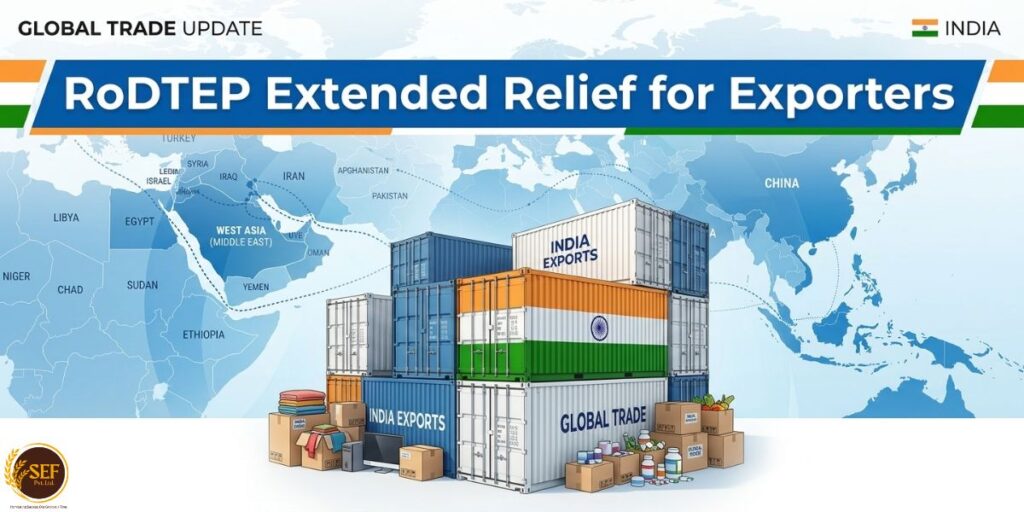
India has extended support to exporters as global trade faces fresh disruptions. The government has prolonged benefits under the RoDTEP scheme until September 30, 2026. This move aims to reduce financial pressure caused by rising logistics costs and geopolitical instability in West Asia.
The decision comes at a time when exporters are already dealing with shipping delays, higher insurance premiums, and volatile freight rates.
What is the RoDTEP Scheme?
The Remission of Duties and Taxes on Exported Products (RoDTEP) scheme was launched in 2021. It refunds hidden taxes and duties that exporters incur during production and distribution.
These costs often remain unrecovered through other central or state mechanisms. The scheme ensures exporters stay competitive in global markets.
Refund rates under RoDTEP range between 0.3% and 3.9%, depending on the product category.
Extension Details and Government Notification
According to the Directorate General of Foreign Trade, exporters will continue to receive benefits at existing rates and value caps.
The extension applies to all eligible exports made between April 1 and September 30, 2026.
This decision provides continuity and stability at a time when global trade faces uncertainty.
Budget Allocation and Industry Concerns
The government had allocated ₹18,232 crore for the scheme in 2025–26. It proposed an increase to ₹21,709 crore for 2026–27. However, the actual allocation currently stands at ₹10,000 crore.
Exporters have expressed concerns about reduced funding. Many believe higher allocations are necessary to offset rising operational costs.
Impact of West Asia Crisis on Trade
The ongoing tensions in West Asia have disrupted key shipping routes. The conflict intensified after joint military action by the United States and Israel targeting Iran.
As a result:
- Freight rates have increased sharply
- Marine insurance costs have risen
- Shipping schedules have become unpredictable
These factors have raised the overall cost of doing business for exporters.
Trade Data Signals Emerging Pressure
India’s merchandise exports showed early signs of stress. Exports declined slightly by 0.81% year-on-year to USD 36.61 billion in February.
However, the trade deficit narrowed to USD 27.1 billion. Analysts expect a clearer impact in March data, as the conflict began late in February.
Logistics Challenges and Route Disruptions
Exporters now face major logistical challenges. Shipping companies have started adjusting routes to avoid high-risk zones.
Transit times have increased. Costs have also surged due to fuel adjustments and insurance premiums.
These disruptions directly affect sectors involved in export rice from India, especially shipments to West Asia.
Additional Government Relief Measures
To strengthen export resilience, the government has introduced the RELIEF scheme. This initiative, valued at ₹487 crore, focuses on logistics support and trade facilitation.
Officials believe this will help exporters manage risks linked to global supply chain disruptions.
Changes in Import Policies
The government has also updated several import policies:
- Free import of tur and urad extended until March 31, 2027
- Yellow peas imports allowed freely under monitoring system
- Minimum Import Price (MIP) on multi-layer paperboard extended until April 30
These steps aim to balance domestic supply and stabilize markets.
Impact on Indian Rice Trade
The extension of RoDTEP benefits offers indirect support to the rice export sector. Exporters dealing with Indian rice prices and global demand fluctuations may gain some relief.
However, rising freight costs and geopolitical risks continue to challenge margins.
Outlook for Exporters
The RoDTEP extension provides short-term stability. It helps exporters manage rising costs and uncertain trade conditions.
However, long-term recovery depends on geopolitical stability and smoother global logistics.
Exporters will continue to monitor developments closely while adjusting strategies to protect margins.