

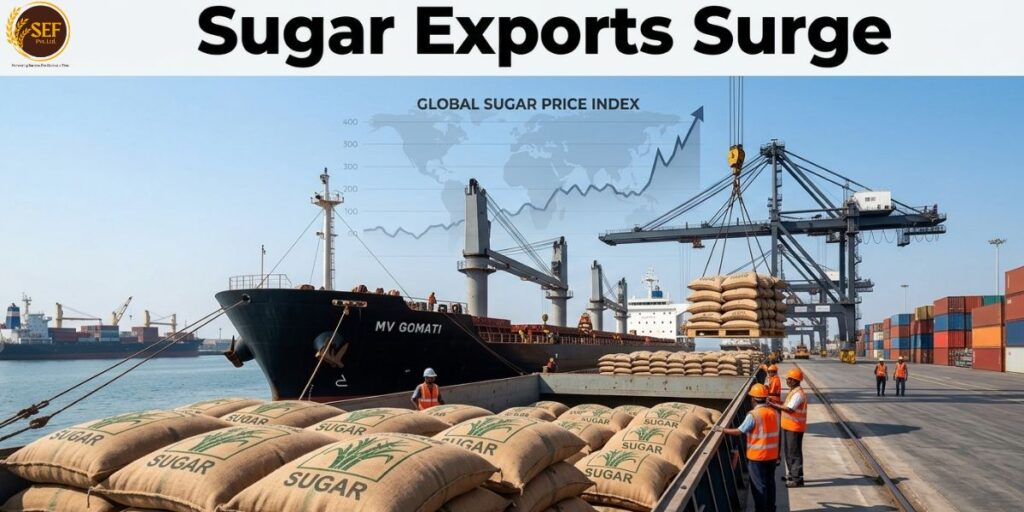
India’s sugar exports have regained momentum after weeks of slow activity. A sharp fall in the Indian Rupee and a rise in global sugar prices have improved export margins. As a result, mills quickly returned to overseas markets.
According to trade sources, exporters signed deals for nearly 100,000 metric tons within a week. This sudden surge signals renewed confidence among sellers.
Weak Rupee Improves Export Competitiveness
The decline in the Indian Rupee has made Indian sugar more competitive globally. Exporters now earn better returns in international markets compared to domestic sales.
At the same time, the Brazilian Real has strengthened. This shift has reduced Brazil’s price advantage, giving Indian suppliers an edge in key regions.
Global Price Rally Driven by Energy Market Trends
Rising crude oil prices have pushed global sugar prices higher. The ongoing tensions in West Asia have increased expectations of higher ethanol demand.
Brazil, the world’s top sugar producer, may divert more sugarcane toward ethanol production. This shift could reduce global sugar supply and support prices further.
Export Deals Expand Across Asia and Africa
Indian mills are actively offering sugar at around $450 per ton on a free-on-board (FOB) basis. Several countries have already secured shipments for April and May.
Key buyers include:
- Sri Lanka
- Djibouti
- Tanzania
- Somalia
These markets are turning to India for cost-effective supply amid rising freight charges.
Export Volumes Expected to Rise Further
So far, Indian mills have contracted around 550,000 tons for export in the current season ending in September.
Industry estimates suggest total exports could reach 1.5 million tons. Demand may increase further from:
- Afghanistan
- Kazakhstan
- Uzbekistan
However, much depends on how global conditions evolve after the ongoing conflict stabilizes.
Government Export Quota Sees Limited Uptake
In February, the government increased the sugar export quota to 2 million tons. It added 500,000 tons to the earlier approved volume.
Despite this move, mills applied for only 87,587 tons from the additional quota. This limited response reflected earlier weak export economics.
Now, with improved pricing conditions, more mills may utilize the remaining quota.
Logistics Challenges Continue to Pressure Trade
Despite stronger demand, exporters still face logistical hurdles. Container shortages and rising freight costs remain key concerns.
However, Indian sugar continues to attract Asian buyers. Freight costs from India to nearby markets remain significantly lower than shipments from Brazil.
Link to Broader Agri Trade Trends
The current shift in sugar exports also connects with wider agricultural trade patterns. Rising costs and geopolitical tensions are influencing multiple commodities.
For example, exporters involved in export rice from India are also monitoring shipping risks closely. Similarly, fluctuations in global trade may impact Indian rice prices in the coming months.
Outlook for Indian Sugar Exports
India’s sugar export outlook has improved in the short term. Strong global prices and currency movements support higher shipments.
However, sustainability depends on:
- Stability in global energy markets
- Freight and logistics conditions
- Currency fluctuations
For now, Indian mills are taking advantage of favorable conditions to expand their global presence.