

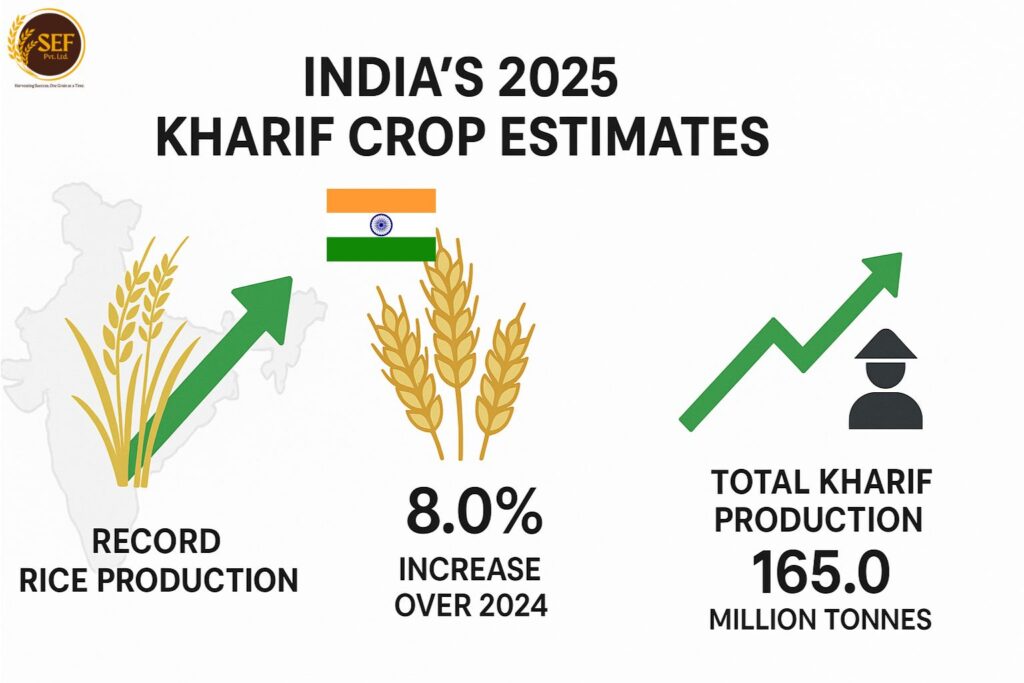
India is poised to achieve a record 124.50 million tonnes of rice in the 2025 kharif season, according to the government’s first advance estimates for the 2025–26 crop year. This marks a 1.4% rise over last season’s output and strengthens India’s leadership in global grain production.
The kharif season, which runs from July to June, plays a crucial role in shaping national food supply. With sowing beginning in June and harvesting starting from October, the 2025 season has already delivered strong early indicators of growth.
Kharif Foodgrain Output Continues to Grow
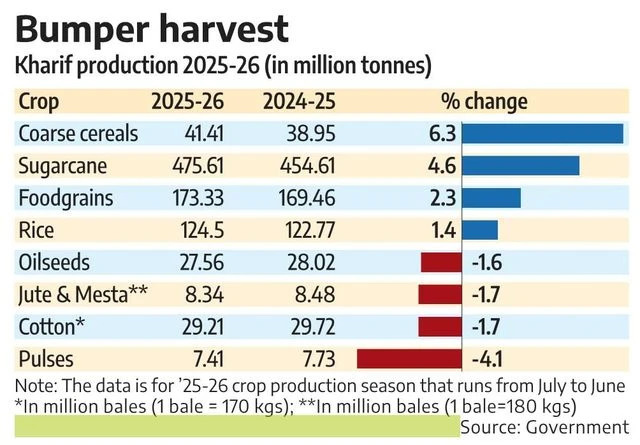
Total kharif foodgrain production is expected to reach 173.33 million tonnes, up by 3.9 million tonnes, or 2.3%, compared to the 2024–25 season. This growth comes despite heavy rainfall in a few regions, as most agricultural zones benefited from a healthy monsoon, Union Agriculture Minister Shivraj Singh Chouhan said while releasing the estimates.
A solid kharif output is also likely to keep inflation in check, especially at a time when rice prices in India fluctuate due to rising demand and export market dynamics.
Rising Inventories May Pressure Government Procurement
India’s growing rice output may push the government to increase procurement in 2025–26. State rice inventories touched 64.31 million tonnes on November 1, more than double the buffer requirement of 30.77 million tonnes.
This year’s bumper harvest could widen that gap even further.
Strong Growth in Maize
The maize harvest for the kharif season is estimated at 28.30 million tonnes, roughly 3.5 million tonnes higher than last year. This rise reflects better yields and improved crop management practices.
Slight Dip in Pulses
Total kharif pulses production is estimated at 7.41 million tonnes, slightly below last year’s 7.73 million tonnes.
Within this:
- Tur (Arhar): 3.59 MT vs 3.62 MT last year
- Urad: 1.20 MT vs 1.34 MT
- Moong: 1.72 MT vs 1.77 MT
Although the decline is marginal, policymakers remain attentive since pulses influence nutritional security and retail pricing.
Mixed Trend in Oilseeds
Kharif oilseeds production is projected at 27.56 million tonnes, marginally lower than last year’s 28.02 million tonnes.
Breakdown:
- Groundnut: 11.0 MT (0.6 MT higher than last year)
- Soybean: 14.26 MT (lower than last season’s 15.26 MT)
Officials noted that yield-based estimates will be revised after field crop-cutting experiments conclude.
Sugarcane and Cotton Output
Other major crops show mixed trends:
- Sugarcane: 475.61 MT (up by nearly 21 MT)
- Cotton: 29.21 million bales (slightly lower than 29.72 million bales last year)
These shifts align with national cropping patterns and changing market preferences among farmers.
ICAR Strongly Rejects Bias Claims in Gene-Edited Rice Trials
The Indian Council of Agricultural Research (ICAR) issued a firm rebuttal against allegations of bias in evaluating India’s two new gene-edited rice varieties, Pusa DST-1 and DRR Dhan 100 Kamala.
ICAR emphasized that both varieties performed better than their parent varieties MTU1010 and Samba Mahsuri in their respective target regions across Zone VII in southern India.
Key performance highlights:
- Under alkaline stress, Pusa DST-1 yielded 3,731 kg/ha, outperforming MTU1010’s 3,254 kg/ha a 14.66% improvement.
- Under coastal salinity, Pusa DST-1 delivered nearly 30% higher yield.
ICAR reaffirmed its long-standing, transparent evaluation process under the All India Coordinated Research Project on Rice, which since 1965, has supported the release of over 1,750 rice varieties.
Why This Matters for India’s Rice Trade?
India continues to dominate global exports and remains central to discussions on the top 10 rice exporters in India and the top 10 rice exporters companies in the world.
A record kharif output strengthens India’s supply position and could influence:
- Global export availability
- Domestic market stability
- Future adjustments in MSP procurement
- Shifts in storage and distribution policies
With higher production, India is likely to maintain its leadership in global rice shipments while stabilizing domestic market conditions.
Final Outlook
India’s agricultural outlook for the 2025–26 kharif season appears strong. Higher rice, maize, and sugarcane output may support food security and help stabilise inflation. Updated estimates will follow once crop-cutting experiment data becomes available.