

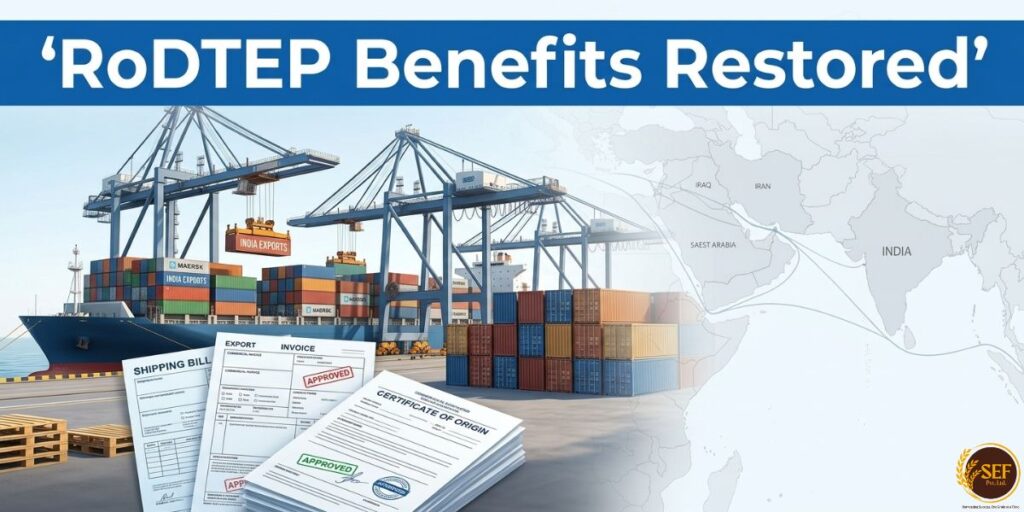
India has restored full benefits under the Remission of Duties and Taxes on Exported Products (RoDTEP) scheme. The decision comes at a time when exporters face rising uncertainty due to tensions in West Asia.
The move offers timely relief to exporters dealing with higher freight costs, insurance premiums, and global trade disruptions.
Government Reinstates Earlier RoDTEP Rates
The Directorate General of Foreign Trade (DGFT) issued a notification confirming the change. According to the update, the government has restored the earlier RoDTEP rates and value caps.
These rates will apply from February 23, 2026, to March 31, 2026.
Earlier, authorities had reduced the benefit rates by half. Exporters raised concerns and requested a review. Now, the government has responded by reinstating the original structure.
What the RoDTEP Scheme Means for Exporters?
The RoDTEP scheme, launched in 2021, supports exporters by refunding hidden taxes and duties. These costs often arise during manufacturing and distribution but remain unrecovered under other systems.
The refund rates range between 0.3% and 3.9%. The scheme helps improve export competitiveness in global markets.
At present, the scheme remains valid until March 2026.
Budget Allocation and Industry Concerns
The government allocated ₹18,232 crore for the scheme in 2025–26. It proposed an increase to ₹21,709 crore for 2026–27.
However, the actual allocation stood at ₹10,000 crore. This gap raised concerns within the exporting community.
Exporters continue to monitor how funding levels may impact future benefits.
West Asia Crisis Adds Pressure on Trade
The ongoing conflict involving the United States, Israel, and Iran has disrupted global trade routes.
As a result, shipping costs have increased. Air freight rates have also moved higher. In addition, insurance premiums continue to rise due to geopolitical risks.
These challenges have created pressure across export sectors, including agriculture and commodities.
Impact on Export Data and Market Trends
India’s merchandise exports declined slightly in February. The total value stood at USD 36.61 billion, marking a 0.81% year-on-year drop.
At the same time, the trade deficit narrowed to USD 27.1 billion compared to the previous month.
However, analysts expect a clearer impact in March data. The conflict escalated on February 28, and its full effect will reflect in upcoming trade figures.
Possible Effect on Indian Rice Prices
The situation may also influence Indian rice prices. Higher logistics costs and uncertain demand from key markets could affect export volumes.
If disruptions continue, exporters may face margin pressure. This could lead to price adjustments in domestic markets as well.
Outlook for Exporters
The restoration of RoDTEP benefits offers short-term relief. However, global uncertainty remains a key risk.
Exporters now focus on managing costs, securing safer trade routes, and maintaining stable supply chains.
The coming months will be critical for assessing the long-term impact of geopolitical tensions on India’s export performance.