

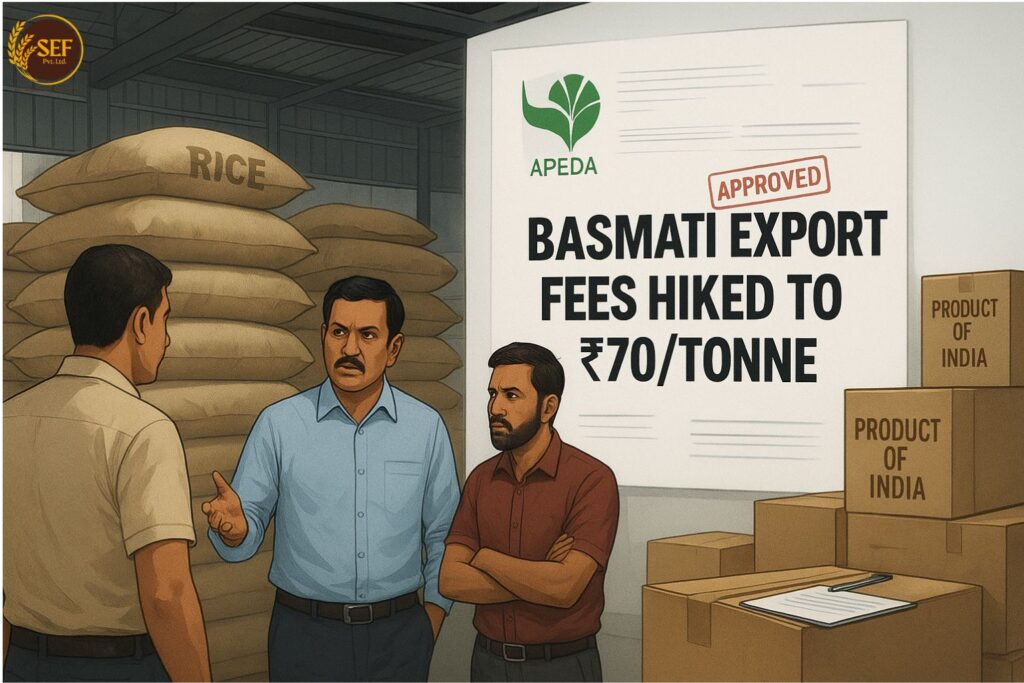
India’s Basmati rice sector has strongly opposed the recent hike in export registration fees. Farmers’ groups from Haryana and Punjab questioned both the timing and justification of the decision. The Agricultural and Processed Food Products Export Development Authority (APEDA) raised the fee for export contracts from ₹30 per tonne to ₹70 per tonne, a sharp 133% jump.
Concerns Over BEDF Fund Utilisation
The higher fee contributes to the Basmati Export Development Foundation (BEDF). Farmers argue the fund already holds nearly ₹25 crore as of March 2025. A BEDF board decision in 2005 stated contributions should resume only when the corpus falls below ₹10 crore.
Exporters recall that the fee was suspended between 2005 and 2012, then reinstated in 2013 and adjusted in 2014. They insist that with rice prices in India already under pressure, extra levies add financial strain. Many also believe the fund should support farmers during crises such as Punjab floods, instead of sitting unused.
Lack of Stakeholder Approval
The Haryana Rice Exporters’ Association (HREA) said the hike was not discussed in the June 2025 BEDF Board meeting. Despite this, APEDA issued a circular in August confirming the increase after approval from the Commerce Ministry. This has raised questions about transparency in decision-making.
Exporters argue the registration fee is not a tax or cess. As a result, its collection and use escape scrutiny. With Basmati exports touching 6.07 million tonnes worth $5.94 billion in FY 2024-25, the higher fee adds significant costs to the trade.
Impact on Export Volumes
Between April and August of the current fiscal, India exported 2.73 million tonnes of Basmati rice valued at $2.38 billion. If the higher fee is applied to upcoming shipments, industry experts estimate that APEDA could collect over ₹23 crore during the rest of the fiscal year, compared to about ₹8 crore in the first five months at the old rate.
While APEDA insists that the revised contribution will help strengthen trade promotion, exporters fear it could impact their global competitiveness, especially as India strives to maintain its leadership among the top 10 rice exporters in India and the top 10 rice exporters companies in the world.
Divisions Among Exporter Associations
Punjab and Haryana associations have openly opposed the hike, while the All India Rice Exporters’ Association (AIREA) has stayed silent. Many exporters worry that regional voices representing the bulk of growers are being sidelined.
Commerce Minister Piyush Goyal had earlier suggested increasing the fee to ₹100 per tonne. Exporters resisted the idea, but the recent jump to ₹70 signals a possible step in that direction. This has sparked concern over further hikes.
Outlook
India’s Basmati exports remain crucial for global markets. Farmers and exporters want the government to reconsider, stressing that trade facilitation and stakeholder confidence matter more than revenue collection.
The debate shows the complex balance India faces in managing agricultural exports protecting farmers, ensuring global competitiveness, and addressing government revenue needs simultaneously.