

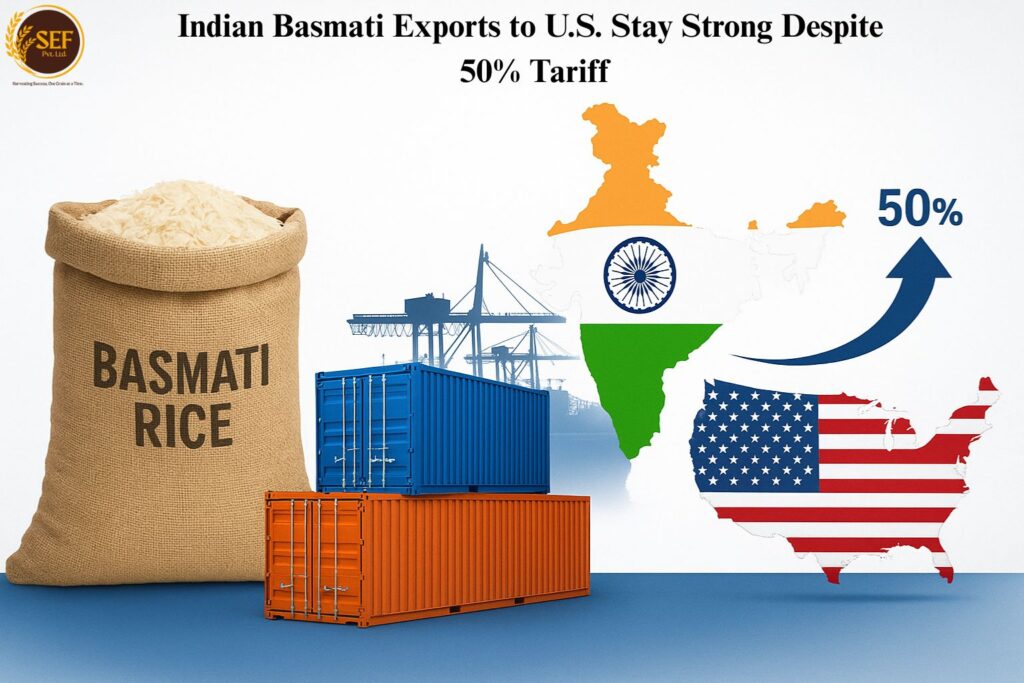
Indian rice exporters have clarified that the recent steep increase in U.S. import duties has not weakened the demand for Indian Basmati rice. According to the Indian Rice Exporters Federation (IREF), shipments to the United States continue steadily because they are driven by advance purchase orders placed by U.S.-based importers.
Exports Continue Even After Sharp Tariff Hike
In 2024–2025, the U.S. increased tariffs on Indian rice from 10% to 50%, a 40-percentage-point jump. Despite the rise, IREF reports that demand remains strong.
The Federation noted that Indian Basmati is an essential commodity for South Asian and Gulf communities in America. These consumers prefer authentic Basmati rice for biryani and traditional dishes, where U.S.-grown substitutes do not match the aroma, elongation, texture, or flavour.
Why U.S. Demand Remains Stable?
IREF explained that U.S.-grown rice varieties cannot replace Indian Basmati in quality or culinary performance. Consumers continue choosing Indian rice because of deep-rooted food habits and a growing interest in Indian cuisine.
Furthermore, retail market data shows that most of the tariff burden has shifted to American consumers. Retail prices for imported rice have increased, while exporter margins in India remain largely unchanged.
This pattern mirrors what happens with other essential commodities too.
India’s Rice Exports to the U.S. in 2024–2025
During FY 2024–25:
- Basmati Rice: 274,213.14 MT worth $337.10 million
- Non-Basmati Rice: 61,341.54 MT worth $54.64 million
The United States is now the 4th largest market for Indian Basmati rice and the 24th largest for non-Basmati rice.
Meanwhile, India’s global rice shipments remain well diversified. Some of the top 10 rice exporters in India continue expanding their presence across the Middle East, Europe, and Africa, strengthening India’s global rice supply footprint.
IREF’s Statement on Trade Stability
According to IREF, Indo–U.S. rice trade is based on:
- Strong consumer preference
- Established culinary traditions
- Consistent product quality
- India’s reliability as a global supplier
They also highlighted ongoing collaboration with the Government of India to expand existing trade routes and open new markets.
Context: Rising Global Demand and Price Sensitivity
The sustained appetite for Indian Basmati in the U.S. comes at a time when rice prices in India are closely tracked due to procurement trends, export policies, and global market shifts.
Despite the tariff shock, Indian exporters remain confident that Basmati’s unique aroma and cooking profile will continue to drive international demand.