

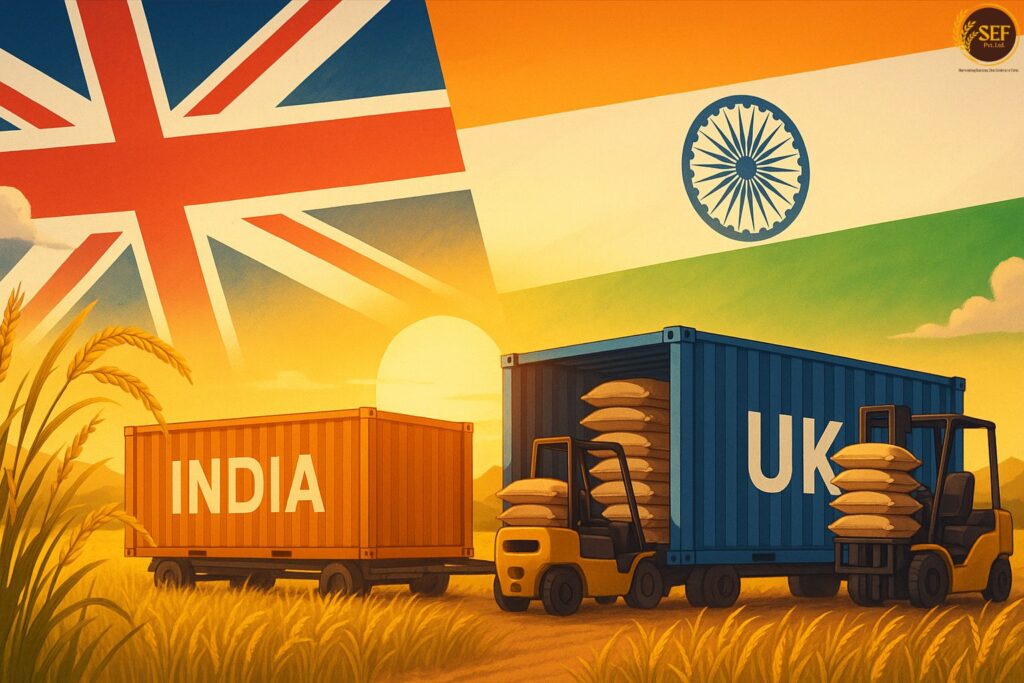
Brown Rice Duty Removed to Enhance Trade
India’s Basmati rice exports to the United Kingdom are set to grow significantly following the India-UK Comprehensive Economic and Trade Agreement (CETA). The removal of customs duties on brown rice is expected to push annual Basmati shipments from the current 1.85 lakh metric tonnes (MT) to 2.5 lakh MT.
The agreement was signed in London in the presence of Prime Minister Narendra Modi and UK Prime Minister Keir Starmer.
Export Potential Strengthens India’s Global Position
Currently, the UK imports nearly 3 lakh MT of Basmati rice annually. Before this deal, Indian exporters were at a disadvantage due to tariff differences favoring competitors like Pakistan.
Under CETA, India gains a level playing field. Exporters believe this shift will lead to a surge in market share, especially for high-demand varieties.
Steady Export Growth Over the Years
India’s Basmati exports to the UK have grown steadily in recent years:
- 1.29 lakh MT in 2021–22
- 1.43 lakh MT in 2022–23
- 1.85 lakh MT in 2023–24
In contrast, Pakistan exported 1.09 lakh MT of Basmati to the UK in the last fiscal year.
GI-Tagged Varieties Included
The agreement includes all GI-tagged Basmati rice varieties, including 1121 and Pusa 1401, which are widely cultivated in Punjab, Haryana, and Madhya Pradesh.
Exporters believe the agreement brings not only export benefits but also increased global recognition for India’s traditional rice varieties.
Punjab Set to Gain the Most
As India’s largest Basmati producer, Punjab contributes around 40% of total output. In 2022, India’s Basmati exports were valued at ₹48,000 crore, and Punjab played a key role in that success.
The state is likely to be one of the biggest beneficiaries of the CETA, boosting both agricultural income and the local economy.
Strategic Access to European Markets
The UK is not just a consumer market. It also acts as a strategic gateway to the rest of Europe.
Indian exporters can now enter other European markets more competitively, thanks to the elimination of UK duties. This could offer advantages to MSMEs, farm producers, and food processors, especially those in northern India.
Efforts to Address Pesticide Concerns
Despite the positive outlook, some concerns remain around pesticide residues in Indian Basmati. However, recent state-level measures have helped address this issue.
Punjab has banned several harmful pesticides over the past three years, and Haryana is taking similar steps. Exporters report that farmer awareness is rising and quality is steadily improving.
Milled Rice Not Included in Duty-Free List
One point of concern is the exclusion of semi-milled and wholly milled rice (HSN Code 1006:30) from the duty-free list.
Exporters describe this as a missed opportunity, noting that continued tariffs may limit export growth in this segment.
95% of Agricultural Products Covered
Under the new CETA, nearly 95% of Indian agricultural exports to the UK will now be duty-free. The list includes:
- Basmati rice
- Millets
- Groundnuts and cotton
- Fruits and vegetables
- Spices and pickles
- Tea and coffee
- Onions and other fresh produce
The agriculture and food processing sectors together account for over 25% of the total trade value under the agreement.
Global Basmati Demand Continues to Rise
In 2023–24, India exported 59.42 lakh MT of Basmati rice worldwide. Major buyers included:
- Saudi Arabia – 11 LMT
- Iraq – 8 LMT
- Iran – 7 LMT
- Yemen – 3 LMT
- United States – 3 LMT
With the UK deal in place, exporters are confident about expanding into more premium markets. This will also strengthen the visibility of Indian rice prices on a global scale.
Final Thoughts
The India-UK CETA is expected to reshape India’s Basmati export landscape. By removing tariffs and recognizing traditional varieties, it opens new opportunities for growth and stability across the farming and agri-processing sectors.
Shah Enterprises continues to support global trade by delivering premium, export-quality rice tailored for international markets.
 Chat on WhatsApp