

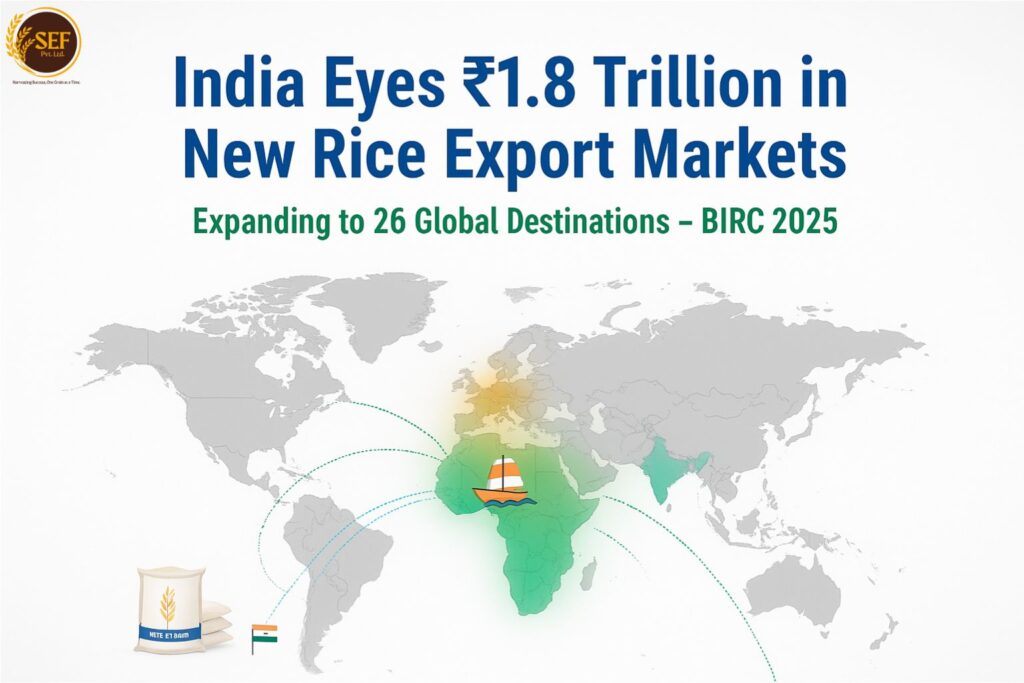
India is gearing up to expand its rice exports by entering 26 new international markets, potentially unlocking trade worth ₹1.8 trillion. This move, led by the Indian Rice Exporters Federation (IREF), aims to strengthen India’s position in markets currently dominated by competitors like Pakistan and Thailand.
India’s Push to Diversify Global Rice Markets
According to Dev Garg, Vice-President of IREF. India has identified Indonesia, Saudi Arabia, Iraq, Vietnam, Japan, Mexico, and China as key targets for expansion.
“These countries together import rice worth ₹1.8 trillion from other suppliers. By introducing Indian varieties, we plan to capture a significant share of that market,” Garg said.
The upcoming Bharat International Rice Conference (BIRC 2025), scheduled for October 30–31, 2025, in New Delhi, will spotlight this strategy. The event will attract over 1,000 global buyers, 2,500 exporters, and 5,000 farmers. Making it one of the largest rice trade events in the world.
India’s Growing Role Among Global Rice Exporters
India remains one of the top 10 rice exporters in the world, supplying to more than 172 countries. It leads both basmati and non-basmati rice exports.
With support from the Agricultural and Processed Food Products Export Development Authority (APEDA). BIRC 2025 will foster collaboration between policymakers, exporters, and researchers.
As a result, India’s presence in the global rice supply chain will continue to strengthen.
Rice Production and Export Performance
India produced around 150 million tonnes of rice in FY25, grown across 47 million hectares, contributing nearly 28% of the global output.
Rice yields have improved significantly from 2.72 tonnes per hectare in 2014–15 to 3.2 tonnes per hectare in 2024–25. Thanks to improved seed varieties, advanced farming techniques, and better irrigation systems.
In FY25, the country exported 20.1 million metric tonnes of ricevalued at approximately $12.95 billion, reinforcing its dominance in the global rice trade.
With competitive rice prices in India and growing international trust, Indian rice continues to attract strong global demand.
BIRC 2025: A Platform for Sustainable and Transparent Trade
The BIRC 2025 conference aligns with the Viksit Bharat @2047 vision. It will bring together exporters, importers, financiers, and researchers to promote sustainable growth, innovation, and transparent trade.
Key discussions will focus on climate-resilient rice varieties, export diversification, and digital traceability to ensure transparency in global trade.
The Commerce Department emphasized that sustainability and efficiency will remain central to India’s export strategy. Furthermore, the nation aims to build a more resilient and responsible rice export ecosystem.
Conclusion
India’s plan to tap into 26 new global markets marks a major step in expanding its rice export footprint. With events like BIRC 2025 and partnerships with global institutions, India aims to boost its agricultural trade and strengthen its place among the top 10 rice exporters in India and globally.
As the world’s largest rice supplier, India’s strategy not only promises economic gains but also promotes sustainable and transparent global trade.