

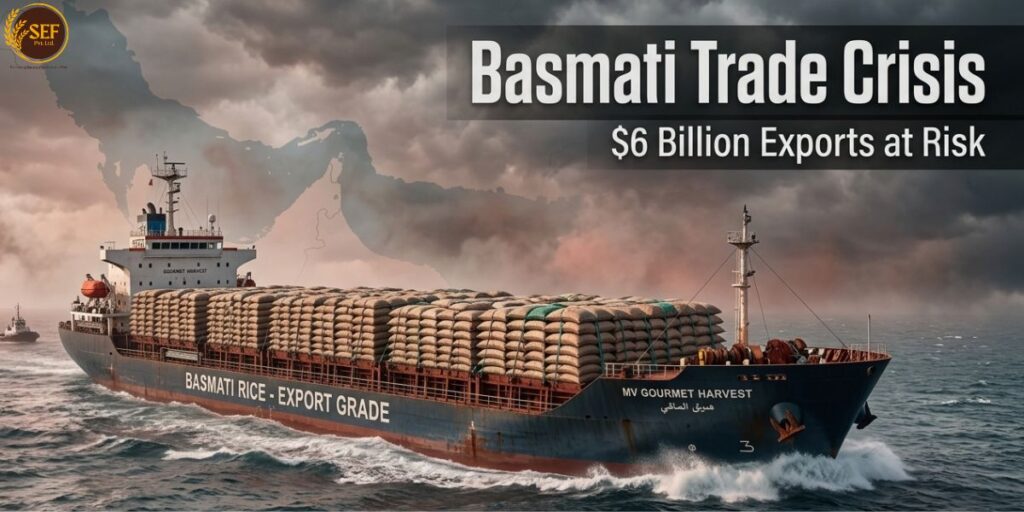
India’s basmati rice export sector is facing a major disruption. Ongoing tensions across West Asia have slowed shipments, increased costs, and delayed payments. As a result, exporters, millers, and farmers now face growing financial pressure.
The conflict has affected a trade valued at nearly $6 billion annually. What started as a geopolitical issue has quickly turned into a supply chain crisis for India’s rice industry.
Trade Routes Disrupted, Shipments Delayed
Export activity has slowed sharply in recent weeks. Key shipping routes across West Asia have become uncertain. Many consignments now face delays at ports, warehouses, and transit points.
Freight costs have also surged. Earlier, exporters paid around $2,500 per container. Now, rates have jumped to $7,000–$9,000. At the same time, container availability has dropped, which adds further pressure.
Insurance premiums have increased as well. Shipping companies now treat the region as high risk. This situation has forced exporters to rethink their logistics strategies.
Heavy Dependence on West Asian Markets
India exports over 60 lakh metric tonnes of basmati rice every year. A large share goes to West Asian countries such as Saudi Arabia, Iran, Iraq, and United Arab Emirates.
This strong dependence has now turned into a key risk. When demand slows in these regions, the entire export chain feels the impact.
Stocks Pile Up Across India
Around 10 lakh tonnes of basmati rice is currently stuck across the country. This stock is ready for export but cannot move due to trade disruptions.
Premium varieties like 1121 basmati face an even bigger challenge. These varieties cater to specific consumer preferences in West Asia. Exporters cannot easily redirect them to markets in Europe, Africa, or the United States.
As inventory builds up, pressure increases on storage, pricing, and working capital.
Financial Stress Mounts for Exporters
Exporters are facing serious liquidity issues. Payments worth thousands of crores remain stuck due to delayed shipments and disrupted trade cycles.
At the same time, costs continue to rise. Higher freight charges, increased insurance costs, and blocked inventory have tightened cash flow.
Industry estimates suggest that payments between ₹2,000 crore and ₹25,000 crore are currently delayed. This situation has raised concerns about financial stability across the export sector.
Impact on Farmers and Local Markets
The crisis is now spreading to farmers. Procurement has slowed as mills reduce operations. In key growing regions like Raisen, several rice mills have reduced activity.
If the situation continues, farmers may face lower demand during the next procurement cycle. This could directly affect Indian rice prices at the farm level.
Lower prices and delayed payments may also influence sowing decisions in the coming season.
Seasonal Demand Missed During Festive Period
This period usually sees strong demand from Gulf countries ahead of Ramzan and Eid. Exporters typically operate at full capacity to meet this demand.
However, the ongoing conflict has disrupted this seasonal cycle. Instead of peak exports, the industry is now dealing with delays and uncertainty.
What Lies Ahead for India’s Basmati Industry?
The government is monitoring the situation and exploring possible solutions. However, the future depends largely on how the geopolitical tensions evolve.
If stability returns soon, trade may recover quickly. But if disruptions continue, exporters could face long-term financial stress.
For now, India’s basmati export sector remains under pressure. Stakeholders across the supply chain are waiting for clarity and stability in global trade routes.