

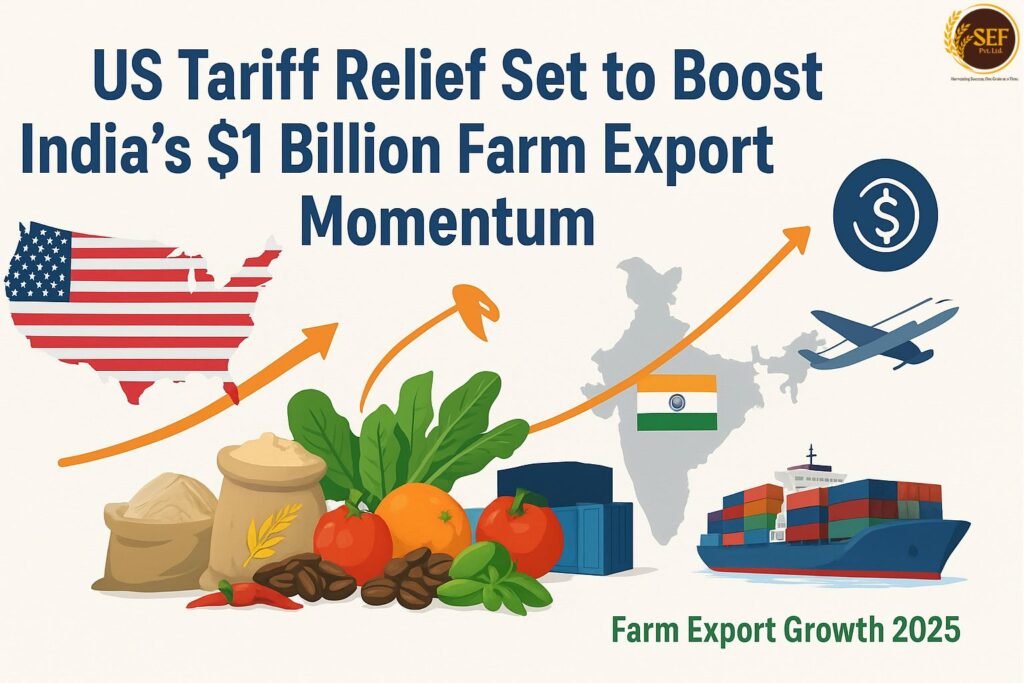
The United States has eased tariffs on several agricultural commodities, creating fresh opportunities for India’s farm exporters. The policy shift improves competitiveness in fruits, nuts, spices, tea, coffee, essential oils, vegetables, bovine meat, and fertilisers. As India continues to strengthen its position in global markets, many traders are closely tracking rice prices in India, which influence export strategies across the sector.
According to senior officials, the exemption now covers agricultural products worth over $1 billion every year. Because of this, Indian exporters expect stronger demand from the US market.
Tariff Relief on High-Value Products
A White House order issued on November 12 removed duties on coffee, tea, tropical fruits, cocoa, spices, bananas, oranges, tomatoes, beef, and specific fertilisers. This move boosts India’s competitiveness, especially in mangoes, pomegranates, spices, and other premium farm items.
However, key export products such as shrimp, seafood, and both basmati and non-basmati rice remain outside the tariff relief list. India still leads the global rice trade, but the US exemption does not yet include grain shipments.
India–US Agri-Trade Continues to Grow
Bilateral agricultural trade between India and the US reached $6.6 billion in 2024. Frozen shrimp dominates India’s exports to the US, while spices, coffee, tobacco, and basmati rice continue to play significant roles.
Between April and October 2025–26, India’s agricultural exports grew 8% to $25.9 billion. Although shipments dipped in October, rice, marine products, meat, fruits, vegetables, coffee, and tea all recorded growth during the seven-month period.
In this broader context, exporters often evaluate market potential by looking at the top 10 rice exporters in India, as these companies shape pricing, logistics, and international demand.
Rice Exports Remain Strong
Even without tariff relief, India’s rice exports increased 5.51% to $6.51 billion** in the first seven months of FY26. In FY25, shipments hit a record $12.47 billion. However, October shipments fell 16% to $0.87 billion. The decline was offset by an 11% rise in marine product exports, according to the Global Trade Research Initiative (GTRI).
Despite fluctuating demand, India maintains its leadership with over 40% of the global rice trade. Exporters highlight the need for predictable policies and smoother logistics to sustain growth.
Strong Momentum Across Other Segments
During April–October 2025–26:
- Marine product exports rose 16% to $4.87 billion
- Meat, dairy, and poultry exports grew 24% to $3.32 billion
- Fruits and vegetables increased 6% to $2.15 billion
- Spices fell slightly by 0.18% to $2.46 billion
While some segments softened in October, the overall trend remains positive.
Conclusion
The US tariff relaxation offers India an important opportunity to expand its agricultural presence. Although rice and seafood remain excluded, high-value products now enjoy improved access to the American market. As the sector grows, industry analysts increasingly track the top 10 rice exporters companies in the world, comparing India’s performance with global competitors. With resilient demand and stronger policy support, India’s agriculture sector is positioned for steady, long-term growth.