

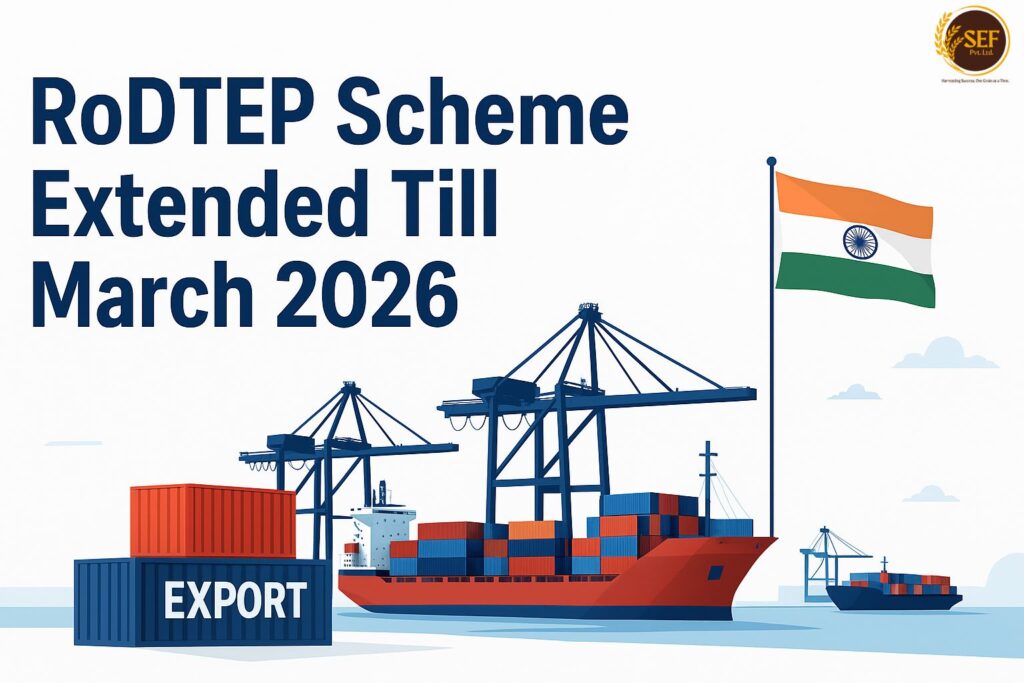
India’s export sector received a boost as the government extended the Remission of Duties and Taxes on Exported Products (RoDTEP) scheme till March 31, 2026. The continuation of this incentive ensures exporters get reimbursements for taxes and levies not refunded through other mechanisms. This move helps Indian goods stay competitive in global markets.
What is RoDTEP?
The RoDTEP scheme, launched in January 2021, neutralises the burden of non-creditable taxes and duties paid during production and distribution. These include central, state, and local levies that exporters cannot recover.
Exporters receive refunds ranging between 0.3% and 3.9% of the shipment value. This lowers overall export costs and makes Indian products more attractive in overseas markets.
Extension Brings Relief to Exporters
The scheme was earlier set to expire on September 30, 2025. Now, the Directorate General of Foreign Trade (DGFT) has extended it by six months, ending on March 31, 2026.
Exporters in Special Economic Zones (SEZs), Export Oriented Units (EOUs), and those with Advance Authorisations (AA) will continue to benefit. Industry bodies such as the Federation of Indian Export Organisations (FIEO) welcomed the extension. They said it gives exporters the confidence to plan ahead amid volatile trade conditions.
Export Growth and Global Context
India’s exports rose 6.7% to $35.1 billion in August 2025, while imports fell by over 10% to $61.59 billion. The continuation of RoDTEP is seen as a critical step to safeguard competitiveness, especially as Indian exporters face tariffs in key markets such as the United States, where certain goods are taxed up to 50%.
The government’s decision comes at a time when exporters are striving to expand market share in competitive regions. For commodities like rice, where rice prices in India often set the benchmark for global buyers, and for sectors where India ranks among the top 10 rice exporters in India and top 10 rice exporters companies in the World, policy stability remains vital.
Why the Extension Matters?
- Policy certainty – Exporters can plan shipments without disruption.
- Global competitiveness – Neutralising tax burdens keeps Indian goods attractive.
- Sector-wide benefit – Coverage extends across multiple industries, from agriculture to manufacturing.
Conclusion
The extension of the RoDTEP scheme until March 2026 reflects the government’s commitment to supporting exporters and sustaining India’s strong position in international trade. With stable incentives, competitive pricing, and a significant role in commodities such as rice and agri-products, India is expected to strengthen its place in the global export landscape.