

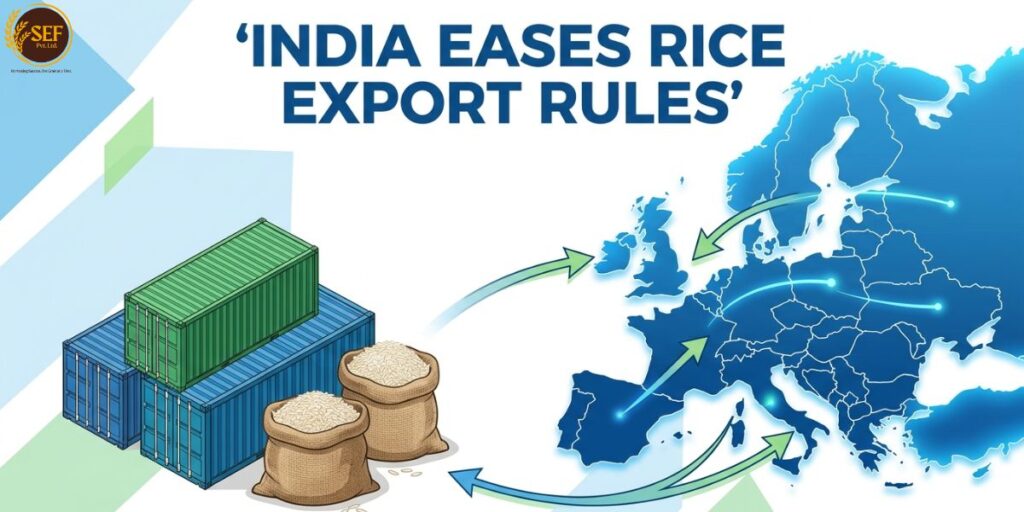
India has simplified its rice export policy for several European nations. The government has reduced documentation requirements to support smoother trade and faster shipments.
The update comes from the Directorate General of Foreign Trade, which issued a fresh notification outlining revised export norms.
Inspection Certificate Now Limited to Select Countries
Under the new rule, exporters must obtain an inspection certificate from the Export Inspection Council or its agencies only for specific destinations.
These include:
- European Union
- United Kingdom
- Iceland
- Liechtenstein
- Norway
- Switzerland
For all other European countries, exporters will not need this certificate for the next six months.
This move reduces compliance pressure and speeds up export processes.
Relief for Exporters and Trade Efficiency
The revised policy allows exporters to focus on faster shipments. It also lowers documentation costs.
Earlier, exporters had to secure inspection certificates for multiple markets. That process often delayed shipments and increased operational burden.
Now, with fewer restrictions, exporters can improve delivery timelines. This may also help stabilize Indian rice prices in global markets.
Alignment with European Regulations
The government has also updated rules for exporting feathers, skins, and related products.
Authorities will now align these exports with regulations followed by the European Union and the United Kingdom.
Exporters must provide a Veterinary Health Certificate when importing countries require it. This step ensures compliance with international safety standards.
DGFT Extends Honey Export Price Rule
In a separate decision, the Directorate General of Foreign Trade extended the minimum export price (MEP) for natural honey.
The government will continue the $1,400 per tonne MEP until December this year. This extension aims to protect domestic producers and maintain price stability.
New Guidelines for Pet Coke Imports
The DGFT has also introduced a structured process for importing calcined petroleum coke for the aluminium industry.
This material plays a key role in manufacturing. Authorities will allocate import quantities based on recommendations from an Exim facilitation committee.
The updated system ensures better control and fair distribution among industries.
Impact on Indian Rice Trade
The relaxation in export rules could support India’s rice trade in several ways:
- Faster shipment processing
- Lower compliance costs
- Improved exporter competitiveness
- Stable Indian rice prices in international markets
Europe remains an important market for Indian rice exports. Easier regulations may strengthen trade ties and boost volumes in the coming months.
Conclusion
India’s decision to ease rice export rules reflects a balanced approach. The government aims to simplify procedures while maintaining quality standards for key markets.
With reduced barriers and clearer guidelines, exporters can operate more efficiently. This policy shift may support growth in India’s rice exports and enhance its global position.