

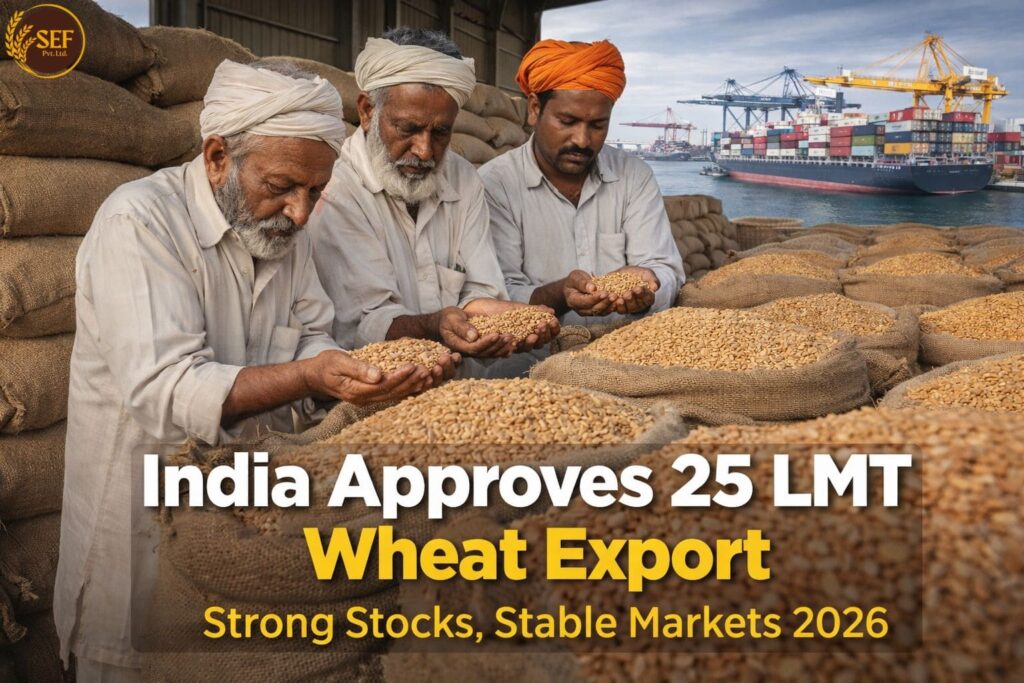
The government on Friday approved the export of 25 lakh tonnes of wheat, along with an additional 5 lakh tonnes of wheat products and sugar each, after reviewing current stock and price conditions.
The Food Ministry said the decision aims to stabilise domestic markets while ensuring better returns for farmers.
Strong Stock Position Supports Decision
Private wheat stocks during 2025-26 stand at nearly 75 lakh tonnes. This figure is around 32 lakh tonnes higher than last year during the same period. Officials believe this indicates a comfortable supply situation.
Meanwhile, wheat availability in the central pool remains strong. As of April 1, 2026, the Food Corporation of India (FCI) holds approximately 182 lakh tonnes of wheat. The ministry stated that exports will not affect domestic food security.
Higher Acreage Signals Robust Harvest
Farmers expanded wheat acreage in Rabi 2026 to 334.17 lakh hectares, compared to 328.04 lakh hectares last year. Assured MSP procurement has strengthened farmer confidence. As a result, another strong harvest is expected.
Why the Export Decision Matters?
The government observed softening prices and high stock levels during peak arrivals. Therefore, it allowed exports to prevent distress sales. The move is expected to:
- Improve market liquidity
- Support farmer incomes
- Enable efficient stock rotation
- Maintain price stability
Sugar Export Quota Expanded
In addition to wheat, the government approved an extra 5 lakh tonnes of sugar exports for the 2025-26 sugar season.
Earlier, authorities had permitted 15 lakh tonnes of sugar exports in November 2025. However, mills exported only about 1.97 lakh tonnes by January 31, 2026. They have contracted another 2.72 lakh tonnes so far.
The additional sugar quota requires mills to export at least 70% of their allocation by June 30, 2026. Authorities will distribute quotas on a pro-rata basis. Mills must confirm participation within 15 days.
Broader Impact on Agricultural Trade
Although this decision focuses on wheat and sugar, it reflects India’s broader approach to managing agricultural exports. Market stability plays a crucial role in commodities such as wheat and rice.
Fluctuations in grain trade often influence Indian rice prices, especially when global supply dynamics shift. India continues to remain among the top 10 rice exporters in India, and policy decisions like these shape the environment to export rice from India efficiently while protecting domestic consumers.