

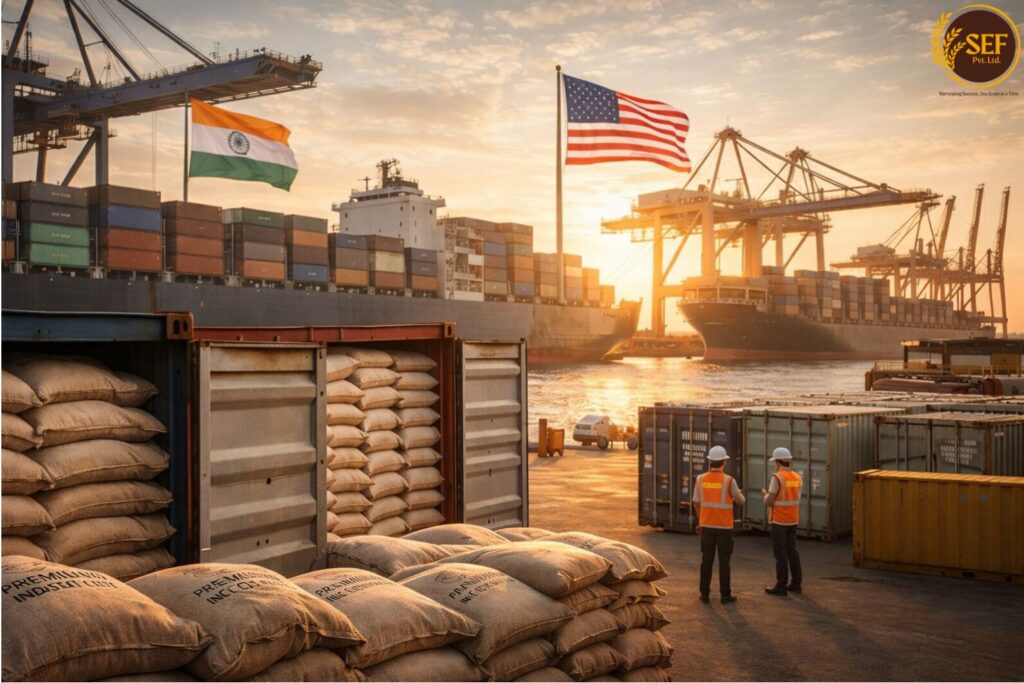
The recent India-US trade agreement is expected to significantly improve rice export from India to USA, according to the Indian Rice Exporters Federation (IREF). The deal restores tariff parity for Indian rice with competing suppliers such as Thailand and Pakistan, improving India’s competitiveness in the US market.
Tariff reduction eases cost pressure
In an official statement, IREF said the reduction in US import duties from 50% to 18% would sharply reduce landed costs for Indian rice. Competing exporters, including Thailand and Pakistan, currently face tariffs of around 19%, placing India back on an even footing.
Prem Garg, National President of IREF, said the development comes at a crucial time. India is entering the season with record rice output, strong availability, and stable domestic fundamentals. These factors support export momentum despite fluctuations in Indian rice prices.
Export resilience highlights strong demand
IREF pointed out that Indian rice shipments to the US continued to rise even when tariffs jumped sharply last year. This trend reflects steady demand among American buyers and consumers.
According to the Federation, tariff parity is likely to translate into higher export volumes. It may also improve price positioning across both basmati and non-basmati segments. Industry participants believe this could help India defend and expand its market share in the US.
Positive outlook for exporters
Dev Garg, Vice President of IREF, said the Federation will work closely with exporters to ensure smooth adaptation to any procedural changes. He added that stable, rules-based trade remains essential for global food supply chains.
The Federation also addressed concerns related to India’s trade with Iran. It said current signals do not indicate disruption and expects export continuity under evolving trade frameworks.
Broader market impact
With India already ranked among the top 10 rice exporters in India, the tariff reset could strengthen its global standing. Exporters expect improved demand sentiment across major markets as pricing competitiveness improves.